
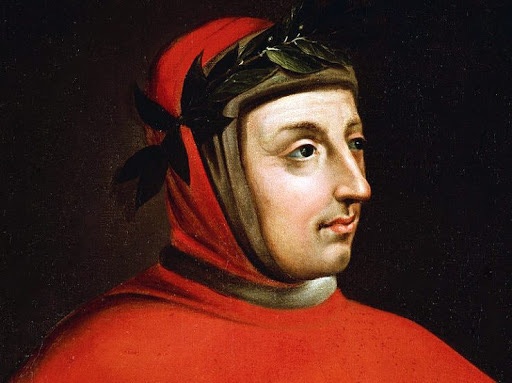
An innovative scholar, poet, and humanist. This Italian writer did it all.
The life of Petrarca
He was born in Arezzo in 1304. Between 1319 and 1323, Petrarca devoted himself to studies in Montpellier, and then proceeded to study law in Bologna. Eventually, he felt the attraction towards Latin literature and writing. Petrarca composed many sonnets in Avignon. Even in his youth, critics admired his work.
After his father’s death in 1326, he stayed in Avignon to work for Cardinal Colonna. During this time, he found time to write his lyrics and sonnets. However, Petrarca had yet to meet the woman who would become his ultimate inspiration.
Hello, Laura
It was April 6, 1327. Petrarca saw her first at the church of Sainte-Claire d’Avignon. Suddenly, he was the most beautiful woman ever. At the time, Laura was 19 years old. And already the wife of Hugues de Sade. The Italian writer poured his emotions into writing.
From this well of passion, Petrarca wrote of boundless and indescribable love for which there was no cure. His love went unreciprocated, but it did not stop him from becoming completely enthralled just by being in Laura’s presence. Though he agonized over the thought of his unreturned love, it was still a feeling he celebrated in many sonnets. In Canzoniere, Petrarca chronicled his first encounter with Laura and the unspeakable desires it provoked. His portrayal of Laura in his writing defied the typical image of women in writing and surpassed it to paint women as spiritual creatures of immense depth and ability.
Writing in Latin
Petrarca believed his Latin works to be his best. One of Petrarca’s most famous Latin work was Africa, an epic that shed light on the practices of the Roman republic. Some of his other works in Latin include the Letters, On Contempt for the Worldly Life, and On Solitude. Although Petrarca favored his Latin works, critics offer equally high praise for all of his work. As years passed, Petrarca’s compositions gained more fame among the people, and in 1341, he was crowned as a poet laureate in Rome. With this title came charges for diplomatic duties on Petrarca’s part, and as he traveled through northern Italy, he realized that his fame was becoming more universal. His writing had earned him international celebrity.
Just as his popularity was rising, however, Petrarca suffered a devastating emotional blow.
The Plague
In Petrarca’s time, the Bubonic Plague was still running rampant throughout Europe. Unfortunately, he fell ill. In 1348, Laura died from it. The grief caused by Laura’s death inspired as many sonnets and poems as did his love for her when she was living. To ease his pain, Petrarca continued to travel throughout the land, and finally settled down around 1367 in Padua. He spent his remaining years in various religious services. Petrarca died on July 18, 1374 in Arqua in the Euganean Hills. He left behind a small sum of money to his friend Boccaccio, as well as numerous works of literature that would gain even more fame after his death.
Petrarca’s contribution to literature
Petrarca’s devotion to achieving new heights in the work of literature would earn him a name for centuries. His literary works would leave a strong impact on literature in Western Europe, and would influence the path that literature would take in the years after his death. There are many critics who suggest that perhaps Laura was merely a fictional character of Petrarca’s fantasies. No matter what Laura’s true existence was, there is no doubt that she inspired some of the greatest love lyrics of all time and that she aided Petrarca in becoming one of the most inspirational Italian writers in all of history.
Selected works for bookworms:
- Opera
- Africa
- De Viris Illustribus
- Secretum meum
- De Vita Solitaria
- An Rerum Memorandarum Libri
- De Remediis Utriusque Fortunae
- Itineraruim
- De sui Ipsuis Et Multorum Ignorantia
Story by: Elizabeth Walling and Tina Samuels