One Hundred Years of Sexy Existence
The history of the brassiere, or the bra, as it has come to be commonly known, is intimately tied to the history of women. The first bra as we know it emerged in 1907 and in 2007 this controversial piece of intimate wear has completed a journey of 100 years. During this journey it has not only seen changes in a woman’s ideal physical shape, it has also been an indicator of the social rise of women in the last century.
The Bra in Italy
A bigger bust was not always a sign of feminine beauty, even in the Roman antiquity. Instead of the reggiseno used by Italian women today, well-endowed girls wore the mammillare which actually reined in the growth of breasts, and women wore the strophium, which made the chest look smaller.
Evolution of the Bra
The bra, on the other hand, has evolved from various supportive garments like the bustier that have been used in the Western world to attain that elusive ideal—the hourglass figure. The ancient Greeks had invented intimate wear for women similar to the brassieres, and bear witness to the real physical necessity of a supportive garment to uphold the female chest.
The word brassiere sounds French, and it actually derives from the French word braciere, meaning “bodice”. The English took the French term to “mean support of the breasts”, and adapted it as “brassiere” in the English language. Actually, in native French, the term bra means “arm” and the women’s undergarment is the euphemism soutien-gorge, which literally translates to “throat support.” Despite the French history behind its name, the brassiere was formally patented in 1915 by an American lady called Mary Phelps-Jacobs, and soon came to be called only the “bra”.
The modern bra is considered an essential part of the female wardrobe, but the now ubiquitous bra has not always had not always enjoyed this status. From 1910 to almost 1930, Chanel-inspired boyish chests were in fashion, which meant that the fashion-conscious women were looking for garments that suppressed rather than enhanced the bust.
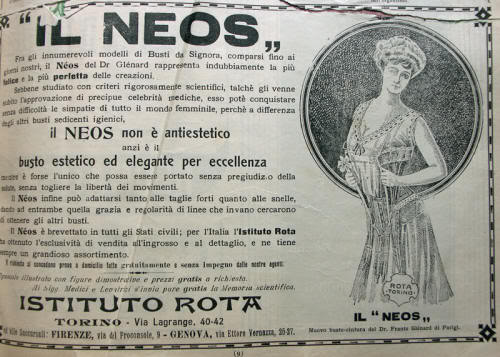
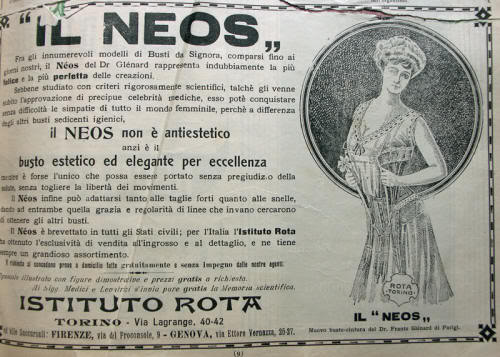
Bra Italy history fashion
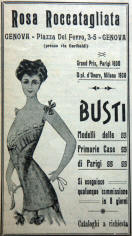
An old advertisement from 1908 about bustiere’s. We know you’ve seen plenty of modern bras anyways!
But by the 1930s, the buxom woman was in fashion again, and of course, the bra made a triumphant re-entry into the world of feminine must-haves. All major bra-making companies came up with simple cotton and net versions to accentuate the feminine form, and Warner made the first popular all-elastic bra. In 1935, Giua la Bruna’s grandfather started up a lingerie workshop in Torino, and the Giua la Bruna brand, which creates some of the most seductive Italian bras, has continued the tradition of quality and comfort down the decades.
In the 1940s, Frederick Mellinger invented the push-up bra, and Lana Turner wore tight, figure hugging sweaters, which made full, firm, pointy breasts all the rage. Bra-designers worked to accommodate the new trend, and push-up bras became extremely popular. The 1940s also showed a change in the sort and amount of fabric used for the bra, because during and after the war, good fabric was in short supply. But technology came to the bra’s aid, and some of the most supportive, yet reasonably-priced fabrics came into the market as this time.
Apart from their utility as a supportive garment, bras were slowly beginning to become a definitive tool for seduction. The size and shape of the bras and the techniques behind their making were all geared towards showcasing the female breasts as objects of desire, of sexiness, and glamour.
Italian Bras
In the 1950’s women began to wear bras not only to support and augment their breasts but to even exaggerate them. This was in answer to the breast-obsessed times dominated by images of women like Marilyn Monroe, Jayne, and Mamie. Anita Ekberg in La Dolce Vita bought this curvaceous ideal into Italy as well. Some of the bras and bustiers worn by Sophia Loren and Ankita Ekberg were custom made for them at the lingerie shop Treppiedi, which was established in the 1960s and is in business even today. It was at this time that Ada Masotti began creating corsets for wealthy women, and the La Perla company, which boasts of some of the world’s best Italian-made bras, was born. Italian bras were never the same again.
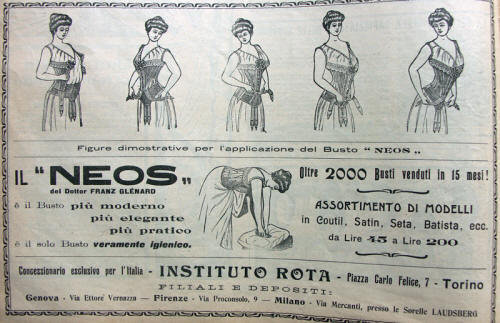
Many different types of bustieres, the predecessor to the bra from 1908
Bras Out of Fashion in the 60’s and 70’s
But through the 60’s and 70’s the bras faced a reversal, partly with the emergence of models like Twiggy who turned super-skinny into ultra-sexy for almost the next two decades. Bra-burning was a term that came to the fore in the 1970’s with women looking upon bras as symbols of patriarchal dominance. Bras were for breasts, and feminists were trying to emphasize a woman’s brains rather than her breasts.
By the 1980’s, however, behind the facade of the high fashion Armani career woman, the bra was witnessing a slow re-emergence. Notably in the work of Jean Paul Gautier whose costumes included conical bras and were sported by Madonna, bras found a new life and made a big comeback in the 1990s. Girls in Europe and America and in some parts of Asia began to flash their bra-straps in the 90’s: sometimes transparent, but often in cute or elegant designs as a fashion statement. Italian fashion has long accepted visible bra straps.
Bras are for health
In its centennial year the bra has adapted itself to the notion that healthy is beautiful. The emphasis is on adequately supporting the weight of the feminine chest for a healthy back. Moreover, with more active lives, women have come to prefer sports bras in a big way. Bras have become a statement of good health and confidence since the turn of the century: inner wear has become outerwear thanks to Nike, Calvin Klein and even the Genie Bra ads in the late 1990’s.Bras have never had it so good.
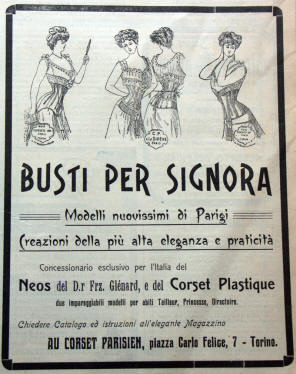
Another bustier advertisement from a large magazine in 1908 from Italy
Bras are here to stay
Women are now comfortable in their own skin, and their bras. With the advent of technology, there is a wide array of types and sizes to choose from which would provide for the wide diversity of feminine forms and clothing. Plastic surgery can now dramatically augment a woman’s assets, and there are just the right sort of bras available to support and display them. It is rather interesting to see older photos that show the changes in the focal points and the amount of skin shown by the bra and other clothes in the past.
Loved and hated in similar amounts during its century-long journey, the bra today celebrates youthful exuberance, seductive sophistication, and mature elegance in equal proportions. It is here to stay. The bra has found its place, literally and figuratively, close to a woman’s heart.
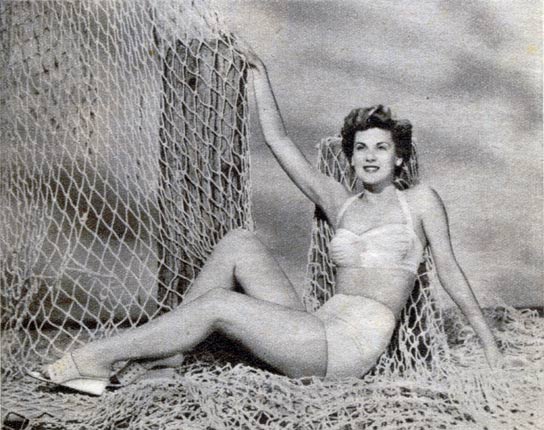
1950’s Bra and swimsuit styling
History of bra : By Damyanti Ghosh
Updated by Damyanti